
Clinical improvement in canine pulmonary hypertension with Perna canaliculus oil (PCSO-524) add-on therapy: Effects on exercise tolerance and cough

 Authors:
1. Abstract
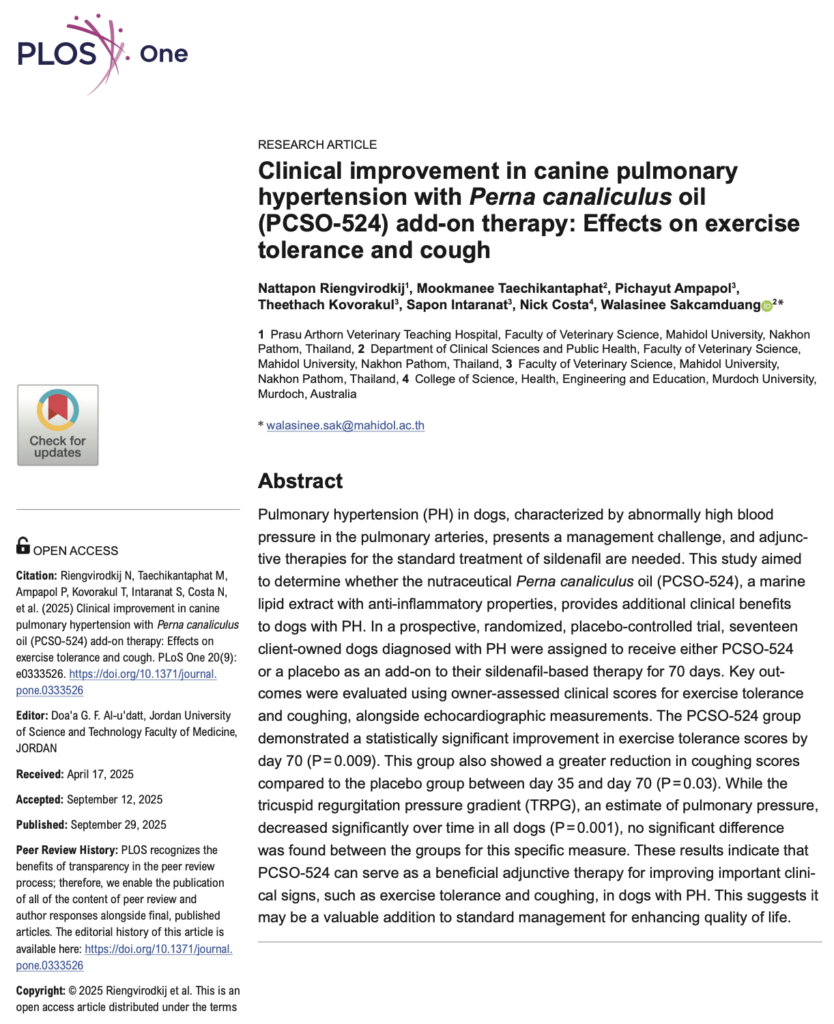
This prospective, randomized, placebo-controlled trial tested green-lipped mussel oil (PCSO-524) added to sildenafil-based therapy in dogs with pulmonary hypertension (PH), mostly secondary to myxomatous mitral valve disease. After 70 days, owner-assessed exercise tolerance improved significantly in the PCSO-524 group (P = 0.009), and the improvement in coughing between Day 35 and Day 70 was greater than with placebo (P = 0.03). The tricuspid regurgitation pressure gradient (TRPG), an echocardiographic estimate of pulmonary arterial pressure, fell in all dogs (P = 0.001), with no difference between groups.
2. Study design
Prospective, randomized (blocked by PH severity, sealed envelopes), blinded, placebo-controlled trial in client-owned dogs aged ≥ 5 years with TR velocity > 3.0 m/s (classified by the authors as intermediate/high PH probability), conducted October 2018 – April 2020. 22 dogs were enrolled and 17 were analysed; most were ACVIM Stage C (B2: 3, C: 12, D: 2). Dogs with other systemic disease, heartworm, or on NSAIDs were excluded.
| PCSO-524 arm | Placebo arm | |
| n (analysed) | 8 (12 enrolled) | 9 (10 enrolled) |
| Test product | PCSO-524 soft gel capsule: 1 capsule twice daily for 2 weeks (loading), then 1 capsule once daily | Identical-looking placebo capsule, same schedule |
| Standard care | Sildenafil (protocol 1 mg/kg PO q12h) plus existing conventional cardiac medications | Same |
| Duration | 70 days (actual visits at Day 0, 35, 70) | 70 days (actual visits at Day 0, 35, 70) |
Outcomes (both arms):
- Clinical scores: owner questionnaire (modified Häggström/QUEST) for exercise tolerance, demeanour, appetite, respiratory effort, coughing and nocturnal dyspnoea/cough.
- Cardiac: echocardiography (incl. TRPG = 4 × TR velocity², LA/Ao, LV dimensions) and ECG.
- Bloods: CBC, serum biochemistry and NT-proBNP.
3. Results
- Baseline: Groups were comparable except for higher plasma protein in the placebo group (P = 0.02) and more severe cough scores in the PCSO-524 group (P = 0.03).
- Exercise tolerance: Improved significantly within the PCSO-524 group (median score 2 → 1; P = 0.009; Day 70 vs Day 0 P = 0.046, vs Day 35 P = 0.014), with no change in the placebo group (P = 0.85). Between-group differences at each visit were not significant; the Day 35–70 change showed a trend favouring PCSO-524 (P = 0.06).
- Coughing: Between Day 35 and Day 70, 4 of 8 PCSO-524 dogs improved vs 0 of 9 placebo dogs (P = 0.03).
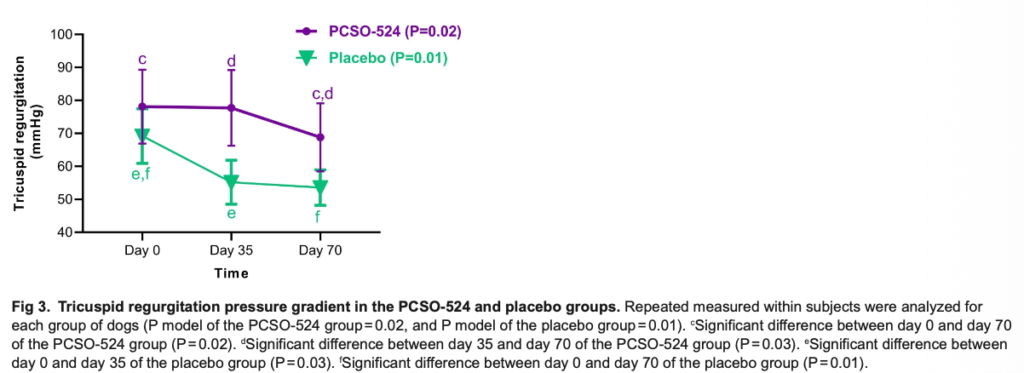
- TRPG: Fell in all 17 dogs (73.4 → 60.7 mmHg; P = 0.001) and within each group (PCSO-524 78.1 → 68.8 mmHg, − 9.3, P = 0.02; placebo 69.2 → 53.6 mmHg, − 15.6, P = 0.01), with no significant difference between groups. The authors attribute the fall to sildenafil and conclude PCSO-524 had no additive pressure-lowering effect.
- NT-proBNP: No significant change in either group.
- Laboratory: At Day 70 the PCSO-524 group had higher RDW (P = 0.01) and neutrophil-to-lymphocyte ratio (P = 0.02) and lower plasma protein (P = 0.03) than placebo; mean values stayed within reference ranges.
- Safety: The authors describe PCSO-524 as safe and well tolerated alongside sildenafil.