Antinol® Latest Studies
Sorted by recent
 Filter Studies by Smart Tags
Bone & JointCardiovascularCase Study & ProceedingCatDogEAB 277™EfficacyExotic PetFighting cockImmunologyNeuro & BehaviorOphthalmologyOralRabbitRenalRespiratoryRodentSafetySkinUTI
Smart Search
การรักษาภาวะเหงือกอักเสบในแมววัยเด็ก ด้วย PCSO-524®


บทคัดย่อ (Abstract)
ภาวะเหงือกอักเสบในแมววัยเด็กแบบไม่มีภาวะเหงือกหนาตัว เป็นภาวะเรื้อรังที่มักส่งผลต่อคุณภาพชีวิตในระยะยาวหากไม่ได้รับการรักษาที่ถูกต้องและเหมาะสม แมวจะเกิดความเจ็บปวด และมีปัญหาในเรื่องการกินได้ ส่งผลให้สุขภาพทรุดโทรมลงเรื่อยๆ การรักษาที่สำคัญ คือ การทำความสะอาดช่องปากร่วมกับการรักษาทางยา เพื่อลดการอักเสบ และ บรรเทาปวด
จากการตรวจช่องปากลูกแมวอายุ 6 เดือนหลังผ่าตัดกราม 1 เดือนพบว่ามีภาวะเหงือกอักเสบระดับปานกลาง จึงทำการรักษาด้วยการทำความสะอาดช่องปาก ร่วมกับ PCSO-524® พบว่าแมวมีภาวะเหงือกอักเสบลดลง การใช้ PCSO-524®ในการรักษาภาวะเหงือกอักเสบในแมววัยเยาว์สามารถช่วยลดการอักเสบได้ ซึ่งเหมาะกับสัตว์ป่วยที่มีข้อจำกัดในการใช้ยาลดการอักเสบกลุ่ม Non-Steroidal Anti-Inflammatory Drugs (NSAIDs) หรือยาในกลุ่มสเตียรอยด์

Use of PCSO-524® (Antinol®) for Treatment of Chronic Pododermatitis in Fighting Cocks
 Authors:
Abstract
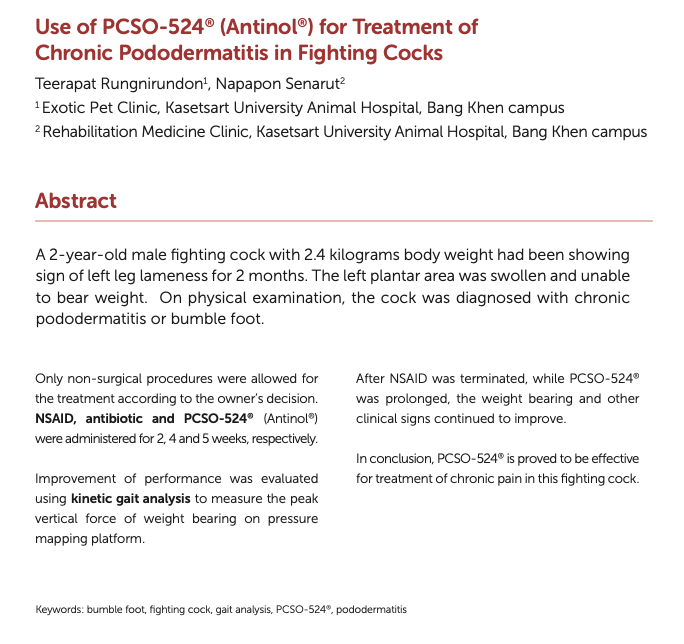
A 2-year-old male fighting cock with 2.4 kilograms body weight had been showing sign of left leg lameness for 2 months. The left plantar area was swollen and unable to bear weight. On physical examination, the cock was diagnosed with chronic pododermatitis or bumble foot.
Only non-surgical procedures were allowed for the treatment according to the owner’s decision. NSAID, antibiotic and PCSO-524® (Antinol®) were administered for 2, 4 and 5 weeks, respectively.
Improvement of performance was evaluated using kinetic gait analysis to measure the peak vertical force of weight bearing on pressure mapping platform.
After NSAID was terminated, while PCSO-524® was prolonged, the weight bearing and other clinical signs continued to improve.
In conclusion, PCSO-524® is proved to be effective for treatment of chronic pain in this fighting cock.
Keywords: bumble foot, fighting cock, gait analysis, PCSO-524®, pododermatitis

Antinol® Case Study Contest 2022

Antinol® Case Study Contest 2020
The 8 Case Studies from Antinol® Case Study Contest of 2020.
________
1st Winning Awards
1) Use of PCSO-524® and Cyclosporin for Treatment of Immune-Mediated Polyarthritis in Dogs
2) Use of PCSO-524® for Supplementary Treatment of Protein Losing Nephropathy in Animals
________
2nd Winning Awards
3) Use of PCSO-524®(Antinol®) in a Pomeranian Dog with Degenerative Mitral Valve Disease (DMVD) and Cardiac Tumor of the Left Atrium
________
3rd Winning Awards
4) Use of PCSO-524 (Antinol®) for Treatment of Chronic Pododermatitis in FIghting Cocks
5) Use of PCSO-524® with Physical Rehabilitation to Regain Mobility in Dogs after Femoral Head and Neck Excision
6) Use of PSCO-524® (Antinol®) and Casting for Treatment of Tetraparesis and Neck Pain Due to Atlantoaxial Instability and Subluxation of the 1st-2nd Cervical Vertebrae
7) Effect of One Year Treatment with PCSO-524® on Feline Dermatophytic Pseudomycetoma


Antinol® Case Study Contest 2018
The 6 Case Studies from Antinol® Case Study Contest of 2018.
Antinol® Contest has been organized successfully for 3 years since 2016 in Thailand.
The key objective of this scientific contest is to encourage knowledges sharing amongst the Vet practitioners on how to treat the companion animals inflammatory cases safely & effectively by using Antinol in conjunctive with others medicines especially the NSAIDs (Non Steroidal anti-inflammation drugs) which is the drug of choices of anti-inflammatory problems.


Nutraceutical Treatment of Feline Fhne and Hip Dysplasia in an 8-Month Old Cat
Authors:
A Persian male cat was diagnosed with right hip luxation and left hip injury. While waiting for surgical treatment, the cat was treated with NSAIDs to control pain and inflammation.
After the operation on the right femoral head (right FHNE), the cat received antibiotics and NSAIDs for 10 and 3 consecutive days, respectively. Two weeks after the operation, the lameness and pain of the right hip, as observed from palpation, still remained, but the cat began to bear partial weight.
PCSO-524® was then prescribed and the gait analysis was performed to measure the angle of joint movement.
The monitoring showed increased angle of joint movement and decreased lameness score. This was consistent with the owner report that described less hiding behavior of the cat and improved high jump performance and better quality of life.


Antinol® Case Study Contest 2017
10 Case Reports using PCSO-524® in combination with the treatment regimen for dogs and cats.
Pharmalink International Ltd. and Vetz Petz® would like to thank everyone involved in this 2017 Antinol® Case Study Contest competition and pay homage to our Professors and Veterinarians who have assisted in the judging of the competition.
This 2017 contest was very special with the inclusion of Professor Duncan Lascelles and the wonderful innovation of the live poll that the audience took part in to choose the Vets choice and favorite presentation.


The Trial Treatment of Feline Osteoarthritis in an Eleven-Year-Old Cat
Authors:
A domestic short hair cat aged 11 years was taken to the hospital due to shaking and weakened hind legs. The cat could not perform high jump for 1 month.
Preliminary diagnosis included early stage of osteoarthritis of left hip and capsulitis.
Pain killers, NSAIDs and gabapentin, were administered but the response was not satisfied. Therefore, multimodal treatment program was initiated. Physical therapy using electrical stimulation and laser beam class 4 in conjunction with PCSO-524® were used. Measurement of joint movement angle (active range of motion; active ROM) in 2 dimensions using Kinovea program was conducted for follow up.
The study found increased active ROM and decreased lameness score after the treatment.
The owner described that the cat showed less isolation behavior and was able to perform vertical jump again. Overall quality of the cat’s life was improved.


Updated Study Topics
New researches and publications related to PCSO-524® and its result in clnical test submitted by veterinarians on the global conferences every year and the data keeps growing with more studies conducted